
Ottawa Building Codes 2026: What Homeowners Need to Know for Renovations
Understanding building codes is essential for any Ottawa homeowner planning a renovation or construction project. The Ontario Building Code, enforced by the City of Ottawa, establishes minimum standards for safety, health, accessibility, and structural integrity that protect you, your family, and future occupants. In 2026, several important updates and enforcement changes make understanding these requirements more crucial than ever for successful project completion.
This comprehensive guide demystifies Ottawa’s building codes, explaining what they are, why they matter, which renovations trigger compliance requirements, and how to navigate the approval process successfully. Whether you’re planning a simple basement finishing, major home addition, or complete renovation, understanding building codes ensures your project meets legal requirements while protecting your investment.
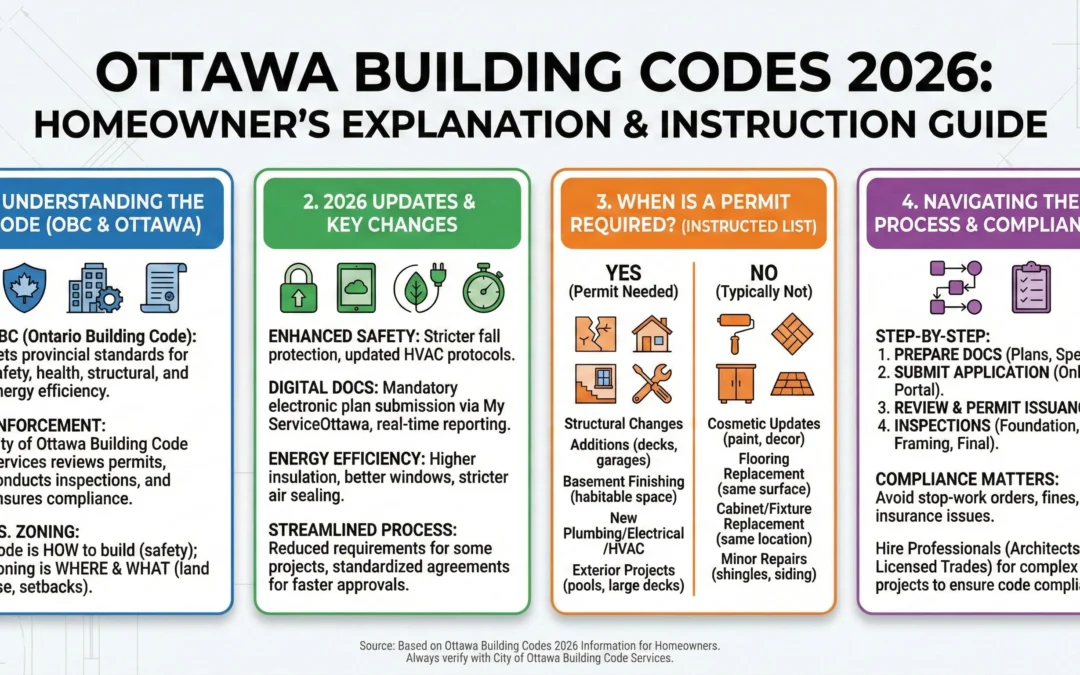
Understanding the Ontario Building Code and Ottawa’s Role
Building codes in Ottawa operate through a two-tier system involving provincial standards and municipal enforcement. Grasping this structure helps you understand who regulates what and where to find information.
What is the Ontario Building Code?
The Ontario Building Code (OBC) is provincial legislation establishing minimum construction standards for all buildings in Ontario. Updated regularly to reflect technological advances, safety research, and energy efficiency goals, the OBC covers:
- Structural Requirements: Load-bearing capacities, foundation design, and framing standards
- Fire Safety: Fire-rated assemblies, egress requirements, and smoke alarm placement
- Plumbing Systems: Water supply, drainage, fixture installation, and backflow prevention
- Electrical Systems: Wiring methods, circuit capacity, outlet placement, and safety devices
- HVAC Systems: Heating, cooling, and ventilation requirements for indoor air quality
- Energy Efficiency: Insulation values, window performance, and building envelope standards
- Accessibility: Barrier-free design requirements where applicable
Ottawa’s Building Code Services
The City of Ottawa’s Building Code Services (BCS) department, led by the Chief Building Official, administers and enforces the Ontario Building Code within city boundaries. Their responsibilities include:
- Reviewing and approving building permit applications
- Conducting inspections at various construction stages
- Issuing occupancy permits upon satisfactory completion
- Investigating complaints about non-compliant construction
- Taking enforcement action against code violations
Building Code vs. Zoning Bylaws: Understanding the Difference
Many homeowners confuse building codes with zoning bylaws, but they serve distinct purposes:
| Building Code | Zoning Bylaws |
|---|---|
| Provincial legislation (OBC) | Municipal regulations |
| Governs how to build | Governs where and what to build |
| Safety, structural, mechanical standards | Land use, setbacks, height, lot coverage |
| Enforced by Building Code Services | Enforced by Planning Department |
| Applies to all construction in Ontario | Specific to Ottawa zones and areas |
Both building codes and zoning bylaws must be satisfied for legal construction. Your project might meet building code requirements but still violate zoning bylaws (or vice versa), so both must be addressed during planning.
2026 Building Code Updates Affecting Ottawa Homeowners
Ontario regularly updates the Building Code to incorporate new safety research, construction technologies, and energy efficiency standards. Several changes effective in 2026 impact residential renovations and construction.
Enhanced Safety Standards
Updated safety requirements strengthen protection for occupants and construction workers:
- Stricter Fall Protection: Enhanced requirements for residential construction including accessory buildings like garden suites
- Updated HVAC Protocols: New mechanical safety standards for refrigerant piping and ventilation systems
- Mandatory Training Certifications: Specific trades working on structural and building envelope systems require updated certifications
Digital Documentation Requirements
The City of Ottawa continues expanding digital submission and tracking systems:
- Electronic Plan Submission: All permit applications submitted through My ServiceOttawa portal
- Real-Time Inspection Reporting: Digital tracking of inspection results and requirements
- Electronic Document Storage: Permits, inspections, and approvals maintained in digital format
This modernization aims to speed approval times while improving record-keeping and accessibility for homeowners and professionals.
Energy Efficiency Reinforcement
Stricter energy standards align with Ontario’s climate goals:
- Higher insulation requirements for walls, ceilings, and foundations
- Improved window and door energy performance standards
- Enhanced air sealing and vapor barrier requirements
- More stringent HVAC efficiency minimums
While these updates increase initial costs slightly, they deliver long-term savings through reduced energy consumption and improved comfort.
Streamlined Approval Process Changes
Ottawa’s 2026 housing action plan includes significant permit process improvements:
- Eliminated Requirements: 13 previously required studies and reports removed for appropriate projects
- Narrowed Scope: 13 additional requirements have reduced scope and complexity
- Standardized Agreements: New template legal agreements replace bespoke contracts, reducing review time
- Fee Structure Updates: Revised building permit fee schedule effective January 1, 2026
These changes aim to accelerate approval timelines while maintaining safety and quality standards.
Which Renovations Require Building Code Compliance?
Understanding which projects trigger building code requirements helps you plan appropriately and avoid violations that can derail projects or create problems when selling your home.
Projects Always Requiring Permits and Code Compliance
The following renovations always require building permits and must meet current building code standards:
Structural Modifications
- Removing or altering load-bearing walls
- Modifying foundation or structural support systems
- Adding or enlarging openings in exterior walls
- Cutting or modifying floor joists or roof rafters
- Installing or removing support columns or beams
Building Additions
- Any horizontal expansion of building footprint
- Second story additions or vertical expansions
- Attached garages or carports
- Covered decks or porches exceeding specific sizes
- Sunrooms or enclosed patios
Basement Finishing and Conversions
- Creating habitable space in previously unfinished basements
- Installing secondary suites or rental units
- Adding bedrooms requiring egress windows
- Any work involving plumbing or electrical systems
New Plumbing Work
- Adding bathrooms in any location
- Installing kitchens or kitchenettes
- Relocating major plumbing fixtures
- Installing sump pumps or drainage systems
- Adding laundry facilities
Major Electrical Work
- Electrical panel upgrades or replacements
- Adding new circuits or substantial wiring
- Installing permanent generators or solar systems
- Adding sub-panels or significantly increasing capacity
HVAC System Changes
- Installing or replacing furnaces or air conditioners
- Adding heating or cooling to previously unconditioned spaces
- Installing wood stoves, pellet stoves, or fireplaces
- Major ductwork modifications or additions
Exterior Projects
- Decks over certain heights or sizes
- Retaining walls over specific heights
- Swimming pools (in-ground or above-ground over certain sizes)
- Detached garages or storage buildings
Projects Typically Not Requiring Permits
These minor renovations usually don’t require building permits, though it’s wise to confirm with Building Code Services:
- Cosmetic Updates: Painting, wallpapering, or decorative finishes
- Flooring Replacement: Installing new flooring over existing surfaces without structural changes
- Cabinet Replacement: Kitchen or bathroom cabinets in existing locations
- Fixture Upgrades: Replacing plumbing fixtures in existing locations without moving supply or drain lines
- Window Replacement: Same-size window replacements in existing openings
- Minor Repairs: Roof shingle replacement, siding repair, drywall patching
Even when permits aren’t required, work must still meet building code standards, especially for electrical or plumbing modifications.
Part 11: Special Rules for Renovating Existing Buildings
The Ontario Building Code includes Part 11, which provides “compliance alternatives” for renovating buildings that have existed for at least five years. This section recognizes that older buildings can’t always meet current standards without unreasonable expense.
Part 11 applies when:
- The structure is at least 5 years old
- You’re maintaining the current major occupancy (e.g., not converting residential to commercial)
- Firefighter access is maintained
- The current performance level of the building is maintained or improved
However, if you substantially remove and replace walls, ceilings, floors, or roof assemblies, affected areas must be upgraded to current code standards. Working with experienced residential architects helps navigate these nuanced requirements.
Key Building Code Requirements for Common Renovations
Understanding specific code requirements for popular renovation types helps you plan budgets, timelines, and design decisions appropriately.
Basement Finishing Code Requirements
Basement renovations must address unique below-grade challenges:
Ceiling Height
- Habitable Space: Minimum 6 feet 5 inches (1.95 meters) for at least 75% of floor area
- Remaining Areas: Minimum 6 feet 1 inch (1.85 meters)
- Mechanical Rooms: May have lower clearances around equipment
Egress Requirements for Bedrooms
- Window Size: Minimum 0.35 square meters (3.8 sq ft) opening area
- Dimensions: At least 380mm (15 inches) in both height and width
- Sill Height: Maximum 1,500mm (59 inches) above floor
- Window Wells: Minimum 760mm (30 inches) from window to well edge
- Ladder Access: Required for wells deeper than 1,500mm
Electrical Requirements
- GFCI protection for outlets near sinks or wet areas
- Adequate number of outlets based on wall length
- Proper lighting in all habitable spaces
- Smoke alarms on every level including basements
- Carbon monoxide alarms if fuel-burning appliances present
Insulation and Moisture Control
- Required insulation values for foundation walls
- Proper vapor barriers to prevent moisture migration
- Adequate ventilation for indoor air quality
Kitchen Renovation Code Requirements
Kitchen projects involve complex code compliance across multiple trades:
Electrical Standards
- Minimum two 20-amp small appliance circuits
- Dedicated circuits for refrigerator, microwave, and dishwasher
- 240V circuit for electric range
- GFCI protection for countertop outlets within 1.5 meters of sinks
- Specific outlet spacing requirements along countertops
Plumbing Requirements
- Proper venting for all drains
- Backflow prevention devices where required
- Gas line connections meeting code for ranges and cooktops
- Shutoff valves accessible for all fixtures
Ventilation
- Range hood exhausting to exterior (or recirculating with adequate filtration)
- Minimum ventilation rates based on kitchen size
- Makeup air requirements for high-CFM range hoods
Bathroom Addition Code Requirements
Bathroom code compliance ensures safety in moisture-prone environments:
Ventilation
- Exhaust fan required (except bathrooms with operable windows)
- Minimum ventilation capacity based on room size
- Exhaust termination exterior to building, not in attic
Electrical Safety
- GFCI protection for all outlets
- Minimum clearances between electrical devices and water sources
- Proper lighting with appropriate ratings for moisture exposure
Plumbing Standards
- Proper trap sizing and venting for all fixtures
- Pressure-balanced or thermostatic mixing valves for showers and tubs
- Minimum clearances around fixtures
- Accessible shutoff valves
Water Resistance
- Water-resistant backing behind tubs and showers
- Proper waterproofing membranes in wet areas
- Vapor barriers to prevent moisture migration
Home Addition Code Requirements
Additions must integrate with existing structures while meeting current standards:
Foundation Standards
- Frost-protected footings below frost line (minimum 4 feet in Ottawa)
- Proper foundation drainage and waterproofing
- Structural connection to existing foundation
Structural Integration
- Proper connections between new and existing framing
- Engineered solutions for load transfer
- Headers and beams meeting span and load requirements
Energy Efficiency
- Wall insulation meeting or exceeding current standards
- Ceiling/roof insulation to required R-values
- Energy-efficient windows and doors
- Proper air sealing and vapor barriers
Fire Safety
- Smoke alarms on all levels
- Carbon monoxide alarms where applicable
- Fire-rated separation between garage and living space if applicable
- Proper egress from all bedrooms
The Building Permit Application Process
Successfully navigating Ottawa’s permit process requires understanding requirements, timelines, and how to prepare complete applications.
Required Documentation
Complete permit applications must include comprehensive documentation:
Core Documents
- Completed Application Form: Available through My ServiceOttawa portal
- Site Plan: Showing property boundaries, existing buildings, setbacks, and proposed construction
- Floor Plans: Detailed layouts of existing and proposed spaces
- Foundation Plans: For projects involving foundation work
- Elevation Drawings: Showing building heights, materials, and appearance
- Section Drawings: Cutting through the building to show construction details
Technical Specifications
- Structural Drawings: Engineered plans for beams, columns, and load-bearing elements
- Electrical Plans: Circuit layouts, panel specifications, and fixture locations
- Plumbing Plans: Supply and drainage layouts with fixture schedules
- HVAC Plans: Heating, cooling, and ventilation system details
- Energy Efficiency Documentation: Insulation values and building envelope details
Supporting Documents
- Survey Certificate: From registered Ontario land surveyor when required
- Structural Engineer’s Seal: For projects requiring engineering analysis
- Architect’s Seal: For projects requiring licensed architect involvement
- Septic Permit: For properties not connected to municipal sewers
Professional architectural drawings meeting Ottawa’s standards are essential for efficient permit approval.
Application Submission and Review Timeline
Submission Process
- Online Portal: All applications submitted through My ServiceOttawa
- Fee Payment: Calculated based on project value ($13-$15 per $1,000 of construction cost)
- Application Acknowledgment: Typically within 1-2 business days
Review Timelines (2026 Estimates)
- Simple Renovations: 2-4 weeks
- Home Additions: 4-8 weeks
- Second Story Additions: 6-10 weeks
- New Custom Homes: 8-12 weeks
- Complex Commercial: 12-16+ weeks
Winter months typically see faster processing due to lower submission volumes, making it an ideal time to submit applications for spring construction.
Review Comments and Revisions
If issues are identified during review:
- Building department issues written comments specifying required changes
- Applicant (typically architect or designer) addresses comments through plan revisions
- Revised plans resubmitted for secondary review
- Process continues until all requirements are satisfied
Permit Issuance and Display Requirements
Once approved:
- Building permit issued digitally through My ServiceOttawa
- Physical permit must be posted visibly on site
- Construction cannot begin before permit is issued
- Permit remains valid for specific duration (typically 12-24 months)
- Extensions available if work isn’t completed within validity period
Building Inspections: What to Expect
Building permits require mandatory inspections at critical construction stages to verify code compliance.
Common Inspection Stages
Foundation Inspection
- When: After footings excavated and formed, before concrete pour
- Verifies: Footing depth, reinforcement, drainage systems
Framing Inspection
- When: After framing complete, before insulation or drywall
- Verifies: Structural members, connections, fire blocking, headers
Rough-In Inspections
- Electrical Rough-In: Wiring, boxes, and panels before covering
- Plumbing Rough-In: Supply and drainage before covering
- HVAC Rough-In: Ductwork and equipment before covering
Insulation Inspection
- When: After insulation installed, before drywall
- Verifies: Insulation values, vapor barriers, air sealing
Final Inspection
- When: After all work complete
- Verifies: All code requirements met, all trades completed properly
- Result: Occupancy permit issued if satisfactory
Scheduling Inspections
- Inspections requested through My ServiceOttawa portal
- Minimum 24-48 hours notice typically required
- Work area must be accessible and ready for inspection
- Permit must be posted on site
- Responsible party should be present to discuss any concerns
Dealing with Failed Inspections
If inspections identify deficiencies:
- Inspector provides written notice of required corrections
- Work may need to be exposed if covered prematurely
- Corrections must be completed before work proceeds
- Re-inspection scheduled after corrections complete
- Additional fees may apply for multiple re-inspections
Common Building Code Violations to Avoid
Understanding frequent violations helps you avoid costly mistakes and project delays.
Structural Violations
- Removing load-bearing walls without proper headers or supports
- Inadequate beam sizing for spans and loads
- Improper connections between structural members
- Insufficient foundation depth or reinforcement
- Missing or inadequate fire blocking in framing
Electrical Violations
- Insufficient number of circuits for electrical load
- Improper wire sizing for circuit capacity
- Missing GFCI or AFCI protection where required
- Inadequate outlet spacing in kitchens or hallways
- Exposed wiring or improper junction box installation
Plumbing Violations
- Improperly sized or missing drain vents
- Incorrect trap installations or missing traps
- Inadequate slope on drainage piping
- Cross-connections between potable and non-potable water
- Missing shutoff valves or backflow prevention
Egress and Safety Violations
- Bedrooms without proper egress windows
- Insufficient window well dimensions or missing ladders
- Improper stairway rise/run ratios or inadequate headroom
- Missing or incorrectly installed smoke alarms
- Inadequate carbon monoxide alarm coverage
Energy Efficiency Violations
- Insufficient insulation in walls, ceilings, or foundations
- Missing or improperly installed vapor barriers
- Inadequate air sealing at building envelope
- Windows or doors not meeting energy performance standards
The Cost of Non-Compliance
Building without permits or ignoring code requirements creates serious consequences that far exceed permit costs.
Financial Consequences
- Stop-Work Orders: Construction halted until compliance achieved
- Fines and Penalties: Municipal fines for unpermitted work
- Remediation Costs: Tearing out non-compliant work and rebuilding properly
- Double Permit Fees: Some municipalities charge double fees for work done without permits
- Property Value Impact: Non-compliant work reduces home value and marketability
Insurance and Liability Issues
- Insurance claims denied for damage related to unpermitted work
- Liability exposure if non-compliant work causes injury
- Difficulty obtaining insurance with known violations
- Personal liability if tenant or visitor injured due to code violations
Real Estate Transaction Problems
- Home inspections revealing unpermitted renovations
- Buyers demanding price reductions or walking away
- Required retroactive permitting before closing
- Delayed closings while compliance issues resolved
- Legal liability for non-disclosure
Legal Consequences
- Municipal prosecution for building code violations
- Court orders requiring remediation
- Liens placed on property until violations corrected
- Difficulty refinancing or obtaining home equity loans
Working with Professionals for Code Compliance
Ensuring building code compliance requires expertise that most homeowners don’t possess. Professional guidance protects your investment and prevents costly mistakes.
When to Hire an Architect
Licensed architects provide essential services for code-compliant design:
- Creating designs that meet building code requirements from the start
- Coordinating with structural engineers and other consultants
- Preparing complete, accurate permit application packages
- Responding to building department review comments
- Providing construction administration to ensure built work matches approved plans
Complex projects like home additions or second story additions benefit enormously from architectural expertise.
The Role of Contractors
Qualified contractors understand building codes and construction best practices:
- Building according to approved plans and code requirements
- Scheduling required inspections at appropriate stages
- Addressing inspector concerns promptly and properly
- Using licensed trades for electrical and plumbing work
- Maintaining documentation of code-compliant materials and methods
Design-Build Advantages
Many Ottawa homeowners choose design build services that integrate design and construction:
- Single point of responsibility for code compliance
- Seamless coordination between design and construction
- Fewer opportunities for miscommunication or errors
- Streamlined inspection process with experienced team
Frequently Asked Questions About Ottawa Building Codes
Do I need a building permit for my renovation in Ottawa?
Most significant renovations require building permits in Ottawa, including structural changes, additions, basement finishing, new plumbing or electrical work, and HVAC installations. Minor cosmetic updates like painting, flooring replacement, or cabinet upgrades typically don’t require permits. When uncertain, contact Building Code Services at 311 or submit an inquiry through My ServiceOttawa. Getting permits for required work protects your investment and ensures safety compliance.
How long does it take to get a building permit in Ottawa?
Building permit approval times in Ottawa vary by project complexity. Simple renovations take 2-4 weeks, home additions require 4-8 weeks, and complex projects like second story additions need 6-10 weeks. New custom homes typically take 8-12 weeks. Winter months often see faster processing due to lower application volumes. Complete, accurate applications with professional drawings expedite approval. Missing information or design issues extend timelines through revision cycles.
What happens if I renovate without a permit in Ottawa?
Renovating without required permits in Ottawa leads to serious consequences including stop-work orders halting construction, municipal fines and penalties, requirements to tear out non-compliant work, insurance claims denial for damage related to unpermitted work, and real estate transaction problems when selling your home. Retroactive permitting is possible but expensive and may require exposing completed work for inspection. Always obtain required permits before starting construction to avoid these issues.
How much do building permits cost in Ottawa?
Ottawa building permit fees are calculated at approximately $13-$15 per $1,000 of construction value. For example, a $100,000 home addition would cost $1,300-$1,500 in permit fees. Small renovations under $10,000 have minimum fees around $150-$300. The updated 2026 fee schedule is available on Ottawa’s Building Code Services website. Permit fees are modest compared to project costs and the protection they provide through code compliance verification.
Can I do my own electrical and plumbing work in Ottawa?
In Ontario, electrical work must be performed by licensed electricians who can obtain electrical permits through the Electrical Safety Authority (ESA). Plumbing work requires licensed plumbers for most installations. Homeowners can perform some basic work on their own properties under supervision, but permits are still required and inspections verify code compliance. For safety and legal compliance, hire licensed professionals for electrical and plumbing work rather than attempting DIY installations.
What are the egress window requirements for basement bedrooms?
Basement bedrooms in Ottawa require egress windows meeting specific Ontario Building Code requirements: minimum opening area of 0.35 square meters (3.8 square feet), minimum dimensions of 380mm (15 inches) in any direction, maximum sill height of 1,500mm (59 inches) above floor, and window wells at least 760mm (30 inches) from window to well edge. Wells deeper than 1,500mm require permanent ladders or steps. These requirements ensure safe emergency exit during fires or other emergencies.
Do old buildings need to meet current building codes when renovating?
Ontario Building Code Part 11 provides “compliance alternatives” for buildings at least 5 years old, recognizing that full upgrades to current standards may be unreasonable. However, if you substantially remove and replace walls, ceilings, floors, or roofs, those areas must meet current codes. The extent of required upgrades depends on renovation scope and existing conditions. Working with experienced architects ensures appropriate code application balancing safety with practical renovation constraints.
What’s the difference between building codes and zoning bylaws in Ottawa?
Building codes (Ontario Building Code) govern how to build safely, covering structural, electrical, plumbing, and HVAC standards enforced by Building Code Services. Zoning bylaws (municipal regulations) govern where and what you can build, including setbacks, height limits, lot coverage, and land use, enforced by the Planning Department. Both must be satisfied for legal construction. Projects might meet building codes but violate zoning, or vice versa, so both require evaluation during planning.
How many inspections are required during construction?
The number of required inspections depends on project scope but typically includes foundation inspection (before concrete pour), framing inspection (before insulation/drywall), rough-in inspections for electrical, plumbing, and HVAC (before covering), insulation inspection (before drywall), and final inspection (after all work complete). Some projects require additional specialized inspections. Your contractor schedules inspections through My ServiceOttawa portal with 24-48 hours notice. Passing all inspections is required before obtaining occupancy permits.
Can architects help ensure my project meets building codes?
Yes, licensed architects are experts in building code compliance and play crucial roles in ensuring projects meet all requirements. Architects design projects that comply with codes from the start, prepare permit applications meeting all technical requirements, coordinate with structural engineers for complex projects, respond to building department review comments, and provide construction oversight ensuring built work matches approved plans. Hiring experienced architects prevents costly code violations and streamlines the permit approval process for complex renovations and additions.
Ensuring Code Compliance for Your Ottawa Renovation
Understanding and complying with Ottawa building codes protects your family’s safety, preserves your property value, and ensures your renovation investment delivers lasting benefits. While building codes can seem complex and intimidating, they exist to establish minimum standards that prevent structural failures, fires, and other hazards that could threaten lives and property.
At Architect Ottawa, we specialize in creating code-compliant designs that meet all Ontario Building Code requirements while delivering the aesthetic appeal and functionality you desire. Our deep knowledge of Ottawa’s building codes, permitting processes, and construction standards ensures your project proceeds smoothly from initial design through final inspection and occupancy approval.
Whether you’re planning a custom home, major renovation, or commercial project, our experienced team handles all aspects of code compliance, preparing comprehensive permit applications, coordinating required engineering, and ensuring construction meets approved plans and building standards.
Ready to start your code-compliant renovation project? Contact Architect Ottawa today for expert guidance:
Phone: (613) 518-3106
Don’t let building code concerns delay your renovation dreams. Our professionals navigate the complexities of Ottawa’s building codes and permit processes, ensuring your project meets all requirements while delivering the results you envision. Schedule your free consultation today and discover how professional architectural services simplify code compliance and protect your investment.
Note: All prices mentioned in this article are provided for general reference and informational purposes only. These prices are not fixed and may vary depending on facts, market conditions, location, time, availability, or other relevant factors. Actual prices may change without prior notice. Readers are advised to verify details independently before making any decisions.